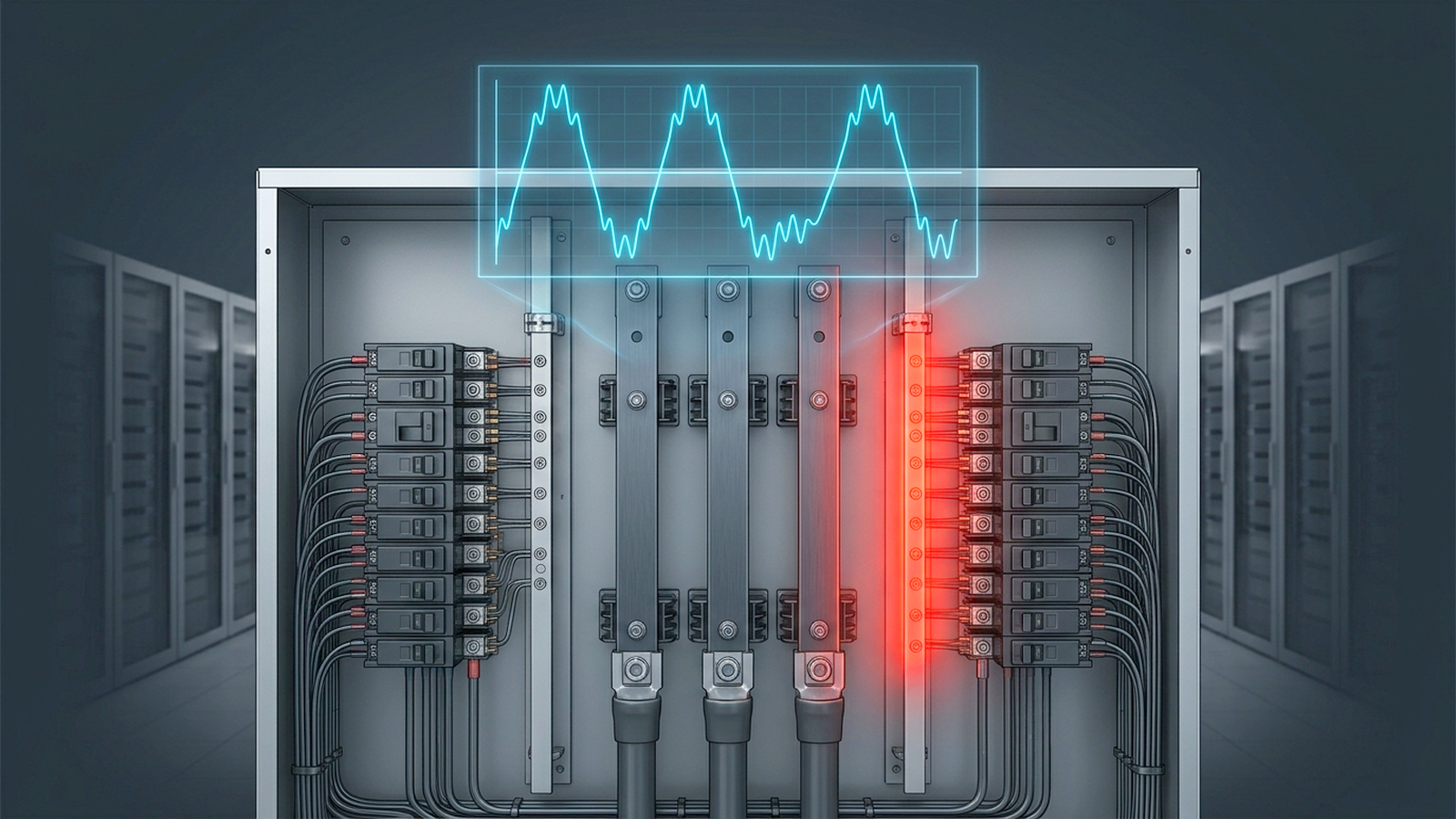

A 208Y/120 V branch circuit can carry three phases and a shared neutral to 120 V outlets in a rack (White Paper 38, p. 5). A published case study calls neutral oversizing of 170% to 200% an unnecessary cost, and says legacy design practices should be updated (White Paper 38, p. 12). It measured a working server room and found neutral currents on the order of 20% of rating (White Paper 38, p. 11). Most of that current came from phases loaded unevenly, not from harmonics (White Paper 38, p. 11).
Why triplen harmonics add in the neutral
At 60 Hz, three balanced phase currents cancel in the neutral (3DFS harmonics page). The third harmonic of each phase arrives in step with the other two, because three times 120 degrees is a full turn (3DFS harmonics page). So third, ninth and fifteenth harmonic currents add in the neutral instead of canceling (3DFS harmonics page). A neutral sized for near zero current can then carry more than a phase (3DFS harmonics page). A 2026 simulation of a 400/230 V network put the neutral at 18 A against 10 A per phase under highly distorted conditions (Lazar et al., Energies 2026).
Why imbalance adds too
The neutral does not need harmonics to carry current. Engineers split any uneven set of three currents into positive, negative and zero sequence parts (3DFS phase balance page). The zero sequence is the part all three legs share, and the neutral carries it back to the source (3DFS phase balance page). Single phase loads land unevenly across the phases (3DFS phase balance page). Loads connected phase to phase do not contribute to the neutral current, and the case study notes such loads particularly in the USA (White Paper 38, p. 3).
Where the 200% figure comes from
The case study notes that triplen currents add in the neutral and that the third harmonic dominates (White Paper 38, p. 3). The design practice it describes rated the neutral of four wire wye feeders and branch circuits in data centers at 173% of the phase current (White Paper 38, p. 4). The paper calls this fine if the load is wholly nonlinear (White Paper 38, p. 4). It says the practice ignores load diversity, the ratio of linear to nonlinear loads in a rack room (White Paper 38, pp. 3 to 4).
The load changed under the rule. The paper says servers, routers, hubs and storage systems almost universally use power factor corrected supplies (White Paper 38, p. 2). It describes these as a very linear load that does not generate harmonic currents (White Paper 38, p. 2).
What the measurements show
The site had a 60 kVA transformer, 480 V delta in and 208Y/120 V out, feeding a 40 kW three phase UPS (White Paper 38, pp. 4 to 5). The UPS fed a PDU panel board supplying 16 rack cabinets over 20 A four wire branch circuits with ground (White Paper 38, p. 5). The study recorded each branch circuit’s current, power factor, current distortion and the odd harmonic orders from the 3rd to the 13th (White Paper 38, p. 5).
None of the 16 three phase branch circuits carried a balanced load (White Paper 38, p. 8). The highest branch load was about 55% of the 16 A conductor rating, and most circuits ran under 30% (White Paper 38, p. 8). Legacy guidelines predicted neutral currents as high as 170% of the 20 A rating (White Paper 38, p. 11). The measured neutrals were on the order of 20% (White Paper 38, p. 11). The dominant source was load imbalance between phases, not harmonic current (White Paper 38, p. 11).
The paper also measured the feeder from the UPS to the panel board. Its phases carried 47.7, 52 and 49.2 A, with current distortion of 11.7%, 13.6% and 14.4% (White Paper 38, p. 11). The neutral carried 19.9 A, about 41.7% of the lowest phase (White Paper 38, p. 11). That neutral was a 1/0 AWG conductor rated at 150 A, so it ran at about 13.3% of its rating (White Paper 38, p. 11).
The study has limits. It studied two installed systems, shows data from one site, and does not describe GPU equipment (White Paper 38). A neutral can still carry more than a phase where triplen harmonics dominate (3DFS harmonics page). So the rule of thumb is a prediction, and a measurement can replace it.
What to measure, in amperes
Read the neutral current on any panel that feeds single phase electronics (3DFS harmonics page). Read the three phase currents and the neutral at the panel, before and after, on the same day and the same load (3DFS phase balance page). Read the transformer temperature after a week (3DFS harmonics page).
For the whole site, ask for a Class A meter reading at the point of common coupling (3DFS harmonics page). Read total demand distortion there against the IEEE 519 table for the site’s short circuit ratio (3DFS harmonics page).
Read amperes beside kilowatts. Harmonic current heats the wire, loads the transformer and pulls the voltage out of shape, but does no work (3DFS harmonics page). The feeders pay for reactive current as I²R loss on current that does no work (3DFS power factor page). A kilowatt reading counts only the working current (3DFS power factor page). The heat rides on the rest.
What correction at the panel changes
Neutral current is a safety issue before a loss, and Software-Defined Electricity reduces it at the panel (3DFS phase balance page). An overloaded or broken neutral is a recognized cause of electrical fires and shock (3DFS products page). The controller supplies the negative-sequence and zero-sequence currents the loads draw. The neutral back to the source then carries far less (3DFS phase balance page).
The controller also corrects harmonics through the 23rd order (3DFS harmonics page). The third, ninth and fifteenth orders that add in the neutral sit inside that range (3DFS data centers page). It rebalances continuously as loads switch, in under 5 microseconds, with no wait for the next wiring pass (3DFS phase balance page).
In a 2020 test at a 208 V panel, the phases carried 13.5, 23 and 9.2 A, with a 15.6 A neutral. With correction on, they read 14.2, 15.4 and 14.5 A, and the neutral read 2 A (3DFS phase balance page). We will send the capture and the method on request (3DFS SDE summary page).
The controller is rated to hold supply side phase currents within 20% of their average (3DFS phase balance page). The harmonic amperes the controller supplies, up to its rating, no longer flow through the feeder, the transformer or the utility meter (3DFS harmonics page). The branch circuits from the panel to the loads keep their own unbalance and harmonic current (3DFS phase balance page, 3DFS harmonics page).
How Software-Defined Electricity is the differentiator for the neutral
The neutral problem is heat where no one is looking. Harmonic current heats the transformer as well as the neutral (3DFS harmonics page). In winding eddy-current loss alone, an ampere of 13th harmonic counts 169 times an ampere at 60 Hz (3DFS harmonics page). That is why K-rated transformers exist (3DFS harmonics page). An overloaded or broken neutral is a recognized cause of electrical fires and shock (3DFS products page).
Correction takes that current off the neutral at the panel. The 2020 test above took the neutral from 15.6 A to 2 A on the same load (3DFS phase balance page). On a server rack, per-phase power read 322, 467 and 788 W, a spread of minus 39% to plus 50%, and correction brought them to 553, 541 and 554 W, within 1.6% of the mean (3DFS phase balance page). While correction runs, the harmonic heating falls for the corrected loads, up to the 23rd order and the unit’s rating (3DFS data centers page).
The gain reaches past the neutral. The measured room fed its PDU panel board from a UPS (White Paper 38, p. 5). Correction on a PDU behind the UPS lightens the UPS inverter and the PDU transformer, and where the limit is a rating in kilovolt-amperes, that rating then carries more useful load (3DFS data centers page).
It also ends the rewiring loop. Each rewiring pass takes hours to days of work, and the job repeats when the loads change (3DFS phase balance page). The controller rebalances continuously as loads switch (3DFS phase balance page). It connects alongside the panel with power on, and commissioning needs no laptop, no software and no configuration (3DFS products page). Two limits stay in view. The branch circuits from the panel to the loads keep their own unbalance and harmonic current (3DFS phase balance page, 3DFS harmonics page). The rack assessment recorded phase power, and no data center neutral-current measurement is on file (3DFS data centers page).
Critical perspective
The case for smaller neutrals rests on one measured room (White Paper 38, p. 4). Its author was the maker’s Senior VP of Innovation and a principal architect of the system measured (White Paper 38, p. 12). The paper names January 1, 2001 as the extended European deadline for its harmonic limits (White Paper 38, p. 2). It prints no date for its own measurements (White Paper 38, p. 4).
The paper’s own numbers deserve a second read. It says power factor corrected supplies do not generate harmonic currents (White Paper 38, p. 2). Its feeder table shows third harmonic current of 11.2% to 13.5% on the three phases (White Paper 38, p. 11). Most branch circuits ran under 30% of their conductor rating (White Paper 38, p. 8). A neutral at 20% of rating on a lightly loaded circuit says little about that neutral at full load.
A GPU hall changes the wiring as well as the load. One current GPU system takes six power supplies, each rated for 200 to 240 V AC (GPU system user guide). On a 208Y/120 V panel such a supply cannot run from a 120 V leg, so it connects phase to phase. The paper says loads connected phase to phase do not contribute to the neutral current (White Paper 38, p. 3). The study measured only a 208Y/120 V system feeding 120 V receptacles (White Paper 38, pp. 4 and 5). Its 20% figure describes that mix, not a hall of phase to phase GPU supplies.
The conclusion for an engineer is narrow. Size the neutral to the code in force, log the neutral on the actual panel, and treat the 20% figure as one room’s result.
Frequently asked questions
Can a neutral in a 208Y/120 V panel carry more current than a phase? Yes, when triplen harmonics dominate the load. Third, ninth and fifteenth harmonic currents add in the neutral instead of canceling (3DFS harmonics page). A 2026 simulation of a 400/230 V network put the neutral at 18 A against 10 A per phase (Lazar et al., Energies 2026). In the measured server room, the branch neutrals ran on the order of 20% of their rating (White Paper 38, p. 11).
What causes neutral current in a server room with power factor corrected supplies? In the measured room, mostly load imbalance between phases (White Paper 38, p. 11). Such supplies present a very linear load (White Paper 38, p. 2). Uneven phases leave a zero sequence current, and the neutral carries it back to the source (3DFS phase balance page).
What does correction at the panel change for the neutral? The controller supplies the negative-sequence and zero-sequence currents the loads draw, so the neutral back to the source carries far less (3DFS phase balance page). In the 2020 test at a 208 V panel, it fell from 15.6 A to 2 A (3DFS phase balance page).
What is the first measurement? Log the three phase currents and the neutral at one panel, before and after, on the same day and the same load (3DFS phase balance page). The case study also recorded the odd harmonic orders from the 3rd to the 13th beside each current (White Paper 38, p. 5).