
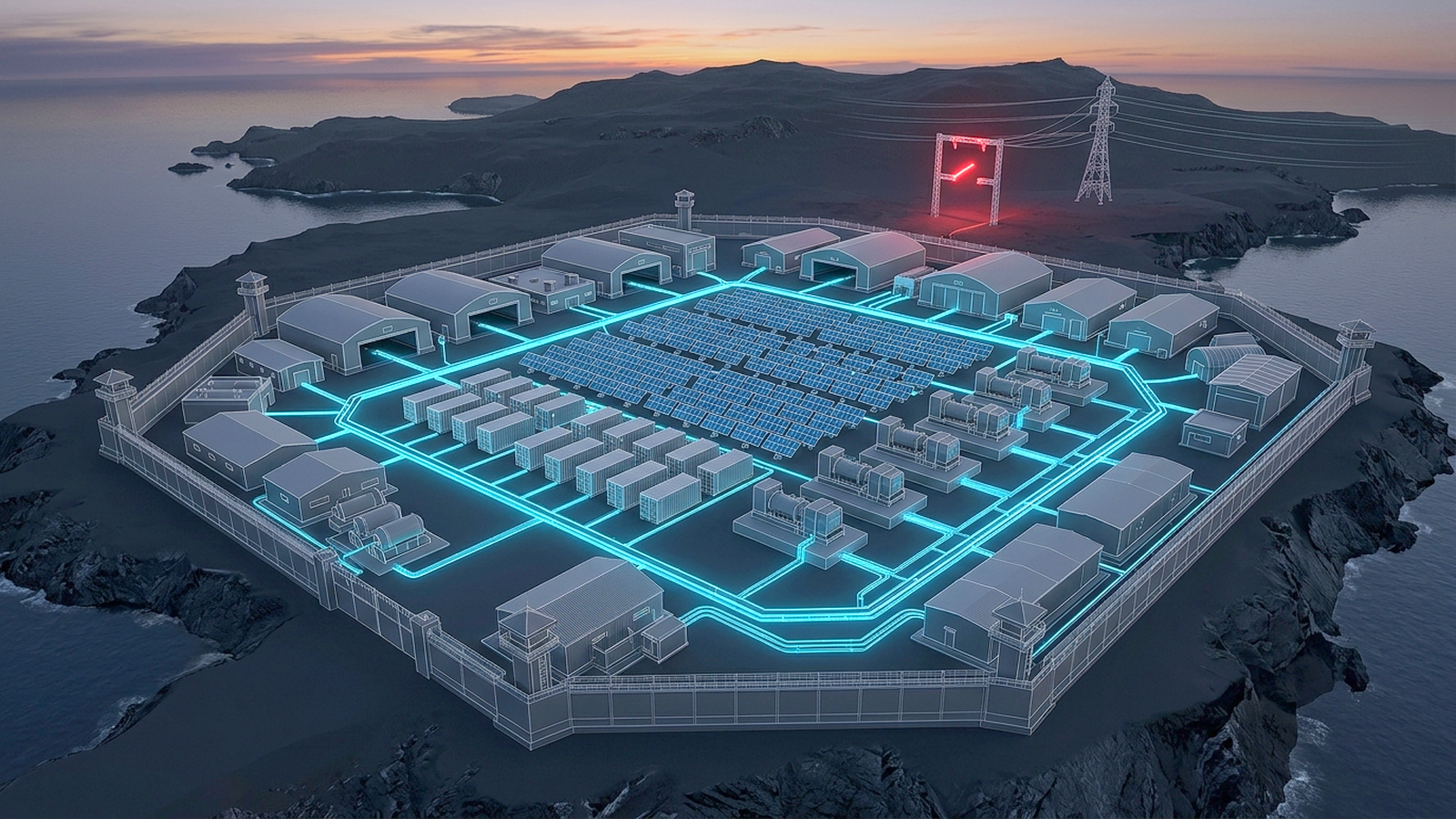

The Pentagon is preparing major military bases in the continental United States to sustain essential operations on their own for at least 90 days, Fox News Digital reported on 25 October 2026 from documents it reviewed. The requirement sits under FORTRESS America, a program the Secretary of War established in a memo dated 30 September 2026. Secretary Pete Hegseth did not say how long the energy goal would take, and a senior defense official said on 20 October that details are still being worked out for around 500 bases in the continental United States (Air and Space Forces Magazine). The electrical point is short. Distorted load current can make a generator’s controls hunt and its windings overheat (our blackstart page, from Army TM 5-689).
What the documents say
The 90 day figure comes from reporting, not from the published memo. Fox News was first to report the 90 day goal, citing documents it said it reviewed (The War Zone, 26 October 2026). The scope covers electricity, water, fuel and communications (Fox News). Pentagon chief spokesman Sean Parnell confirmed the Fox reporting on 25 October (The Epoch Times, 26 October 2026). The War Zone noted that it was unclear whether he explicitly confirmed the 90 day target (The War Zone).
The 30 September memo organizes the program around five pillars, and energy independence is the first (the memo). It gives the Under Secretary of War for Acquisition and Sustainment thirty days to stand up a FORTRESS America Program Office, and it states no 90 day figure (the memo). In his speech the same day, Hegseth said “every major military installation in America is going to generate its own power, independent of the civilian grid” (DefenseScoop, 7 October 2026). An implementation memo of 6 October from Michael Duffey, the Under Secretary of War for Acquisition and Sustainment, named an interim director for the program office (DefenseScoop). DefenseScoop summarized its energy pillar as resilient, sovereign and uninterrupted power generation, distribution and microgrid autonomy across all critical installations (DefenseScoop).
Ninety days is more than six times the Army’s planning default. Army Directive 2020-03 plans to sustain energy and water for a minimum of 14 days when the duration of the critical mission has not been stipulated (Army Directive 2020-03). Federal law requires the energy load for critical missions on each installation to reach a minimum availability of 99.9 percent per fiscal year by the end of fiscal 2030 (10 U.S.C. 2920). The tools named so far are portable nuclear reactors, large battery storage and microgrids that can disconnect a base from the civilian grid (Fox News).
This requirement is not new
The 90 day figure is new. The duty to keep critical missions running through a utility outage is older, and the Department’s own annual reports show how far installations got.
What was already required
The 14 day Army default above has a predecessor. Army Directive 2020-03 supersedes Army Directive 2017-07 of 23 February 2017 (Army Directive 2020-03). The Army reported in March 2017 that the earlier policy called for energy and water for a minimum of 14 days (Army.mil).
DoD Instruction 4170.11 requires generation to be maintained to its technical specifications, a trained operator, fueling plans and fueling contracts (DoDI 4170.11, Change 2). It also requires a full scale test at least once a year, at full operational load and completely separated from the primary source of power (DoDI 4170.11, Change 2).
Section 2920 of title 10 entered the law on 1 January 2021, through section 316(a) of Public Law 116-283 (10 U.S.C. 2920). It requires installation planning to identify how long critical mission energy is likely to be needed in a disruption, but it states no day count (10 U.S.C. 2920). It limits each black start exercise to five days (10 U.S.C. 2920).
What the reports found
The Department put average critical energy system reliability at approximately 99.6 percent in fiscal 2023, short of the 99.9 percent level the law sets for 2030 (FY2023 DoD energy report). The Services completed 23 black start exercises that year, against a target of 15 (FY2023 DoD energy report). Findings from earlier exercises include backup generators that ran severely under their rated load, electrical misconfiguration and improper prioritization of critical loads (FY2023 DoD energy report). In fiscal 2019, 542 of 2,572 unplanned utility outages lasted eight hours or longer (FY2019 DoD energy report).
What 90 days changes
The statutory exercise stops at five days, which is 120 hours. Fourteen days is 336 hours, and 90 days is 2,160 hours.
On fuel, the fiscal 2019 report advised multi fuel backup generators where a natural gas pipeline is available, so that an installation can keep operating in an extended outage that has disrupted the external liquid fuel supply chain (FY2019 DoD energy report). A longer island also gives the electrical limits in the section below more hours to act.
The useful questions for an installation energy manager are how long the longest full load island test ran, and which fuel plan and maintenance schedule would carry day 90.
What 90 days off the grid means electrically
Islanded, a microgrid keeps only the sources on its own side of the breaker (our microgrids page). A standby generator may have 5 to 100 times the sub transient reactance of the normal source transformer (TM 5-689, as cited on our microgrids page). A generator is a weak source (our defense page). Loads that draw harmonic current cause the distortion across the source impedance, and the source itself does not produce it (TM 5-689, paragraph 6-4).
The Army recorded what follows. TM 5-689 records transformers and generators shut down on over temperature while loaded to less than 70 percent of rating (TM 5-689, paragraph 5-7, 2001). The same manual documents speed and frequency controls hunting when harmonics add extra zero crossings, and paralleling then becomes difficult or impossible (TM 5-689, paragraph 5-8). A sizing procedure in the manual sets a standby generator at 1.6 times the UPS input for a 6 pulse rectifier, to contain waveform distortion (TM 5-689, paragraph 6-4).
Battery inverters have a different limit. Inverter based resources generally produce fault current of only 1.1 to 1.5 times rated output current (CIGRE US National Committee, 2019). Synchronous machines generally deliver about six times rated current for several cycles (NREL/TP-550-46698, 2010). Real power, reactive support, harmonic cancellation and fault current all draw on the inverter’s one current budget (our microgrids page).
Where a panel controller fits, and where it does not
Start with the limits. The VectorQ controller does not form the island, dispatch the sources, hold frequency, supply real power, store energy, provide fault current, replace protection or replace the microgrid controller (our defense page). It does not replace a UPS, a sag corrector, a transfer switch or a generator (our resilience page). Ride through belongs to stored energy (our microgrids page).
What it does is narrow. Our controller supplies the reactive, harmonic and imbalance components of load current at the point of use (our microgrids page). Generator governors and voltage regulators then see clean zero crossings (our blackstart page). The harmonic burden that heats the alternator’s damper cage moves to the controller, up to its rating (our resilience page). The controller runs with no internet dependency and corrects at the panel whether the base is on utility or islanded (our defense page).
The video
Our video is titled Power Quality as a Force Multiplier for National Defense.
Questions searchers ask
Do military bases have to run 90 days without the grid? Fox News reported on 25 October 2026 that every major installation in the continental United States would be expected to sustain essential operations independently for at least 90 days (Fox News). The 30 September memo does not state that number (the memo).
What is FORTRESS America? It is a Department of War program, established by memo on 30 September 2026, that the memo calls the nation’s insurance policy (the memo). Its five pillars start with energy independence (Air and Space Forces Magazine).
How long did Army bases plan to run off grid before? Fourteen days, where the mission duration is not stipulated (Army Directive 2020-03).
What happens to generators on a long island? The load’s harmonic current becomes the generator’s problem. TM 5-689 records sets shut down on over temperature below 70 percent of rating, and controls that hunt (TM 5-689).