

A dark grid comes back on low-margin generators and inverters, where inrush, harmonic and unbalanced current pull the voltage down during pickup. We correct that current at the panel, at each pickup step. The U.S.-Canada Power System Outage Task Force reported estimates of $4 billion to $10 billion for the cost of the August 2003 blackout in the United States 12.
Executive summary
More of the source’s rating goes to real power. Our Software-Defined Electricity (SDE) controller sits on the load panel and supplies the part of the current that does no work 8. What it returns depends on the load mix at each pickup step, so the work starts with a measurement.
- Generator restart. Diesel and gas gensets on a restoration path. The generator sees a balanced, sinusoidal load at unity power factor, so its full kVA rating goes to kW 8.
- Battery restart. Grid-forming storage that starts the local grid first. The inverter spends its full rating on real power, in real time and inside the inrush itself 8.
- Cold load pickup. Transformers and motors restarting together. The inrush is brief and heavy in reactive current, and correction at the load supplies that share so the source does not carry it 1,8.
- Motor starts. Loads coming back on a sagging bus. Reactive current supplied at the load holds the bus voltage up, so motors reach speed and the block comes back once 8.
After a blackout, power comes back from the top down. Large plants start first, then the transmission lines, then the local wires. Homes and factories wait until the end. Grid-forming battery storage can now start the local grid first, and a 2026 Nature Communications review explains how 1.
The limit on this approach is the inverter’s apparent power rating. Ingarra proposes that the source feeding an inverter must supply the apparent power, not only the real power 13. When a block of load switches back on, it draws a surge of reactive current. That surge pushes the inverter into current limiting before it can deliver the real power 1.
- Two paths, one problem. Today the grid restarts with synchronous generators, cranking paths and facility gensets. Tomorrow it restarts with grid-forming batteries. On both paths, the source has to carry the cold load pickup.
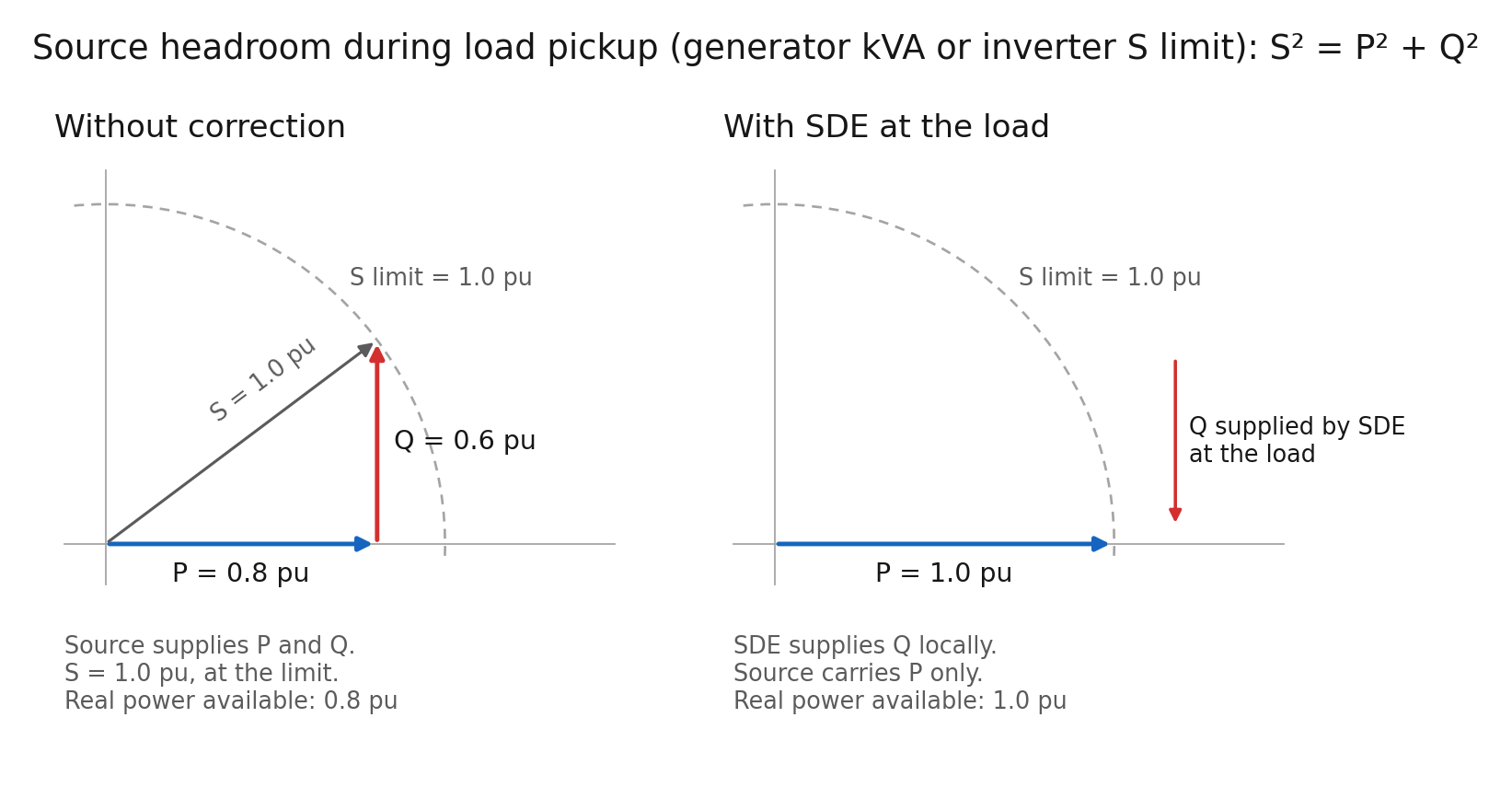
- One rating for real and reactive power. Real and reactive power share one source limit: S² = P² + Q². A source that supplies 0.6 per unit (pu) of reactive power has only 0.8 pu left for real power. This holds for a generator’s kVA rating and an inverter’s apparent power limit 1.
- Cold load pickup. When power returns, every transformer and motor starts at once. The inrush is brief and reactive-rich. Then demand stays high for minutes. In the review’s IEEE 123-node case, one block waited 2 hours 45 minutes for energy margin 1, dark the whole time.
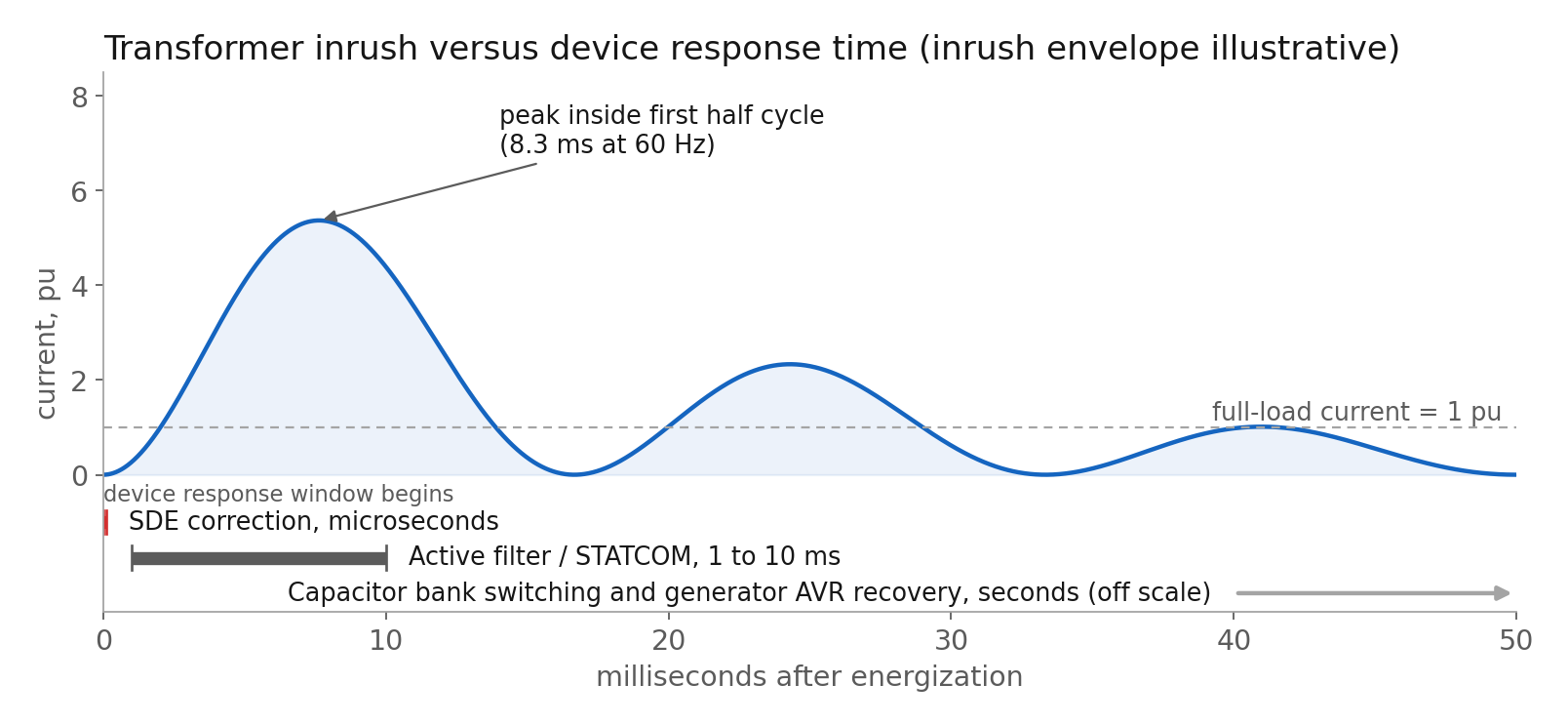
- Every correction device has a speed. Capacitor banks act in seconds 9 and lose output as voltage sags 5. Active filters act in 1 to 10 ms and STATCOMs (static synchronous compensators) in 1 to 5 ms 9. Generator voltage regulators recover over seconds 6. Transformer inrush peaks inside the first 8 ms 4. Correct the current at the load and the bus voltage holds with it.
- Voltage decides whether a load comes back. Loads come back cleanly only when voltage holds. Motor starting torque falls with the square of voltage. A sagging bus stretches every motor start and deepens the sag 3.
- What SDE adds to a blackstart. It gives more headroom per pickup step and stable voltage at the load bus. It also gives a cleaner island waveform for generator controls and grid-following inverters, wider protection margins and sub-cycle waveform data at the point of pickup.
The problem
Large blackouts keep happening: the Northeast in 2003, Great Britain in 2019, Texas in 2021 and Chile in February 2025. In Spain and Portugal in April 2025, a voltage instability cascade caused widespread disconnections across the peninsula 1.
The causes differ. The recovery sequence does not. End users stay dark until the bulk system recovers, even when the wires on their street are intact 1.
Whatever the source, restoration is a sequencing problem. Energize a small network. Hold its voltage and frequency. Add load without collapsing the source.
The load added at each step is not the load on the nameplate. Cold load pickup is the rebound in demand when a block is re-energized after an extended outage, as transformers and motors start together 1. The Nature Communications review describes it in two stages. First comes a brief inrush with substantial reactive power demand. Then comes a thermostat-driven recovery, lasting minutes to tens of minutes, with demand above the pre-outage baseline 1.
Every source shares the one rating described above. Reactive current, harmonic current and imbalance current consume the rating without delivering energy to the load 1,7.
The load side has its own constraint. Induction motor starting torque falls with the square of terminal voltage 3.
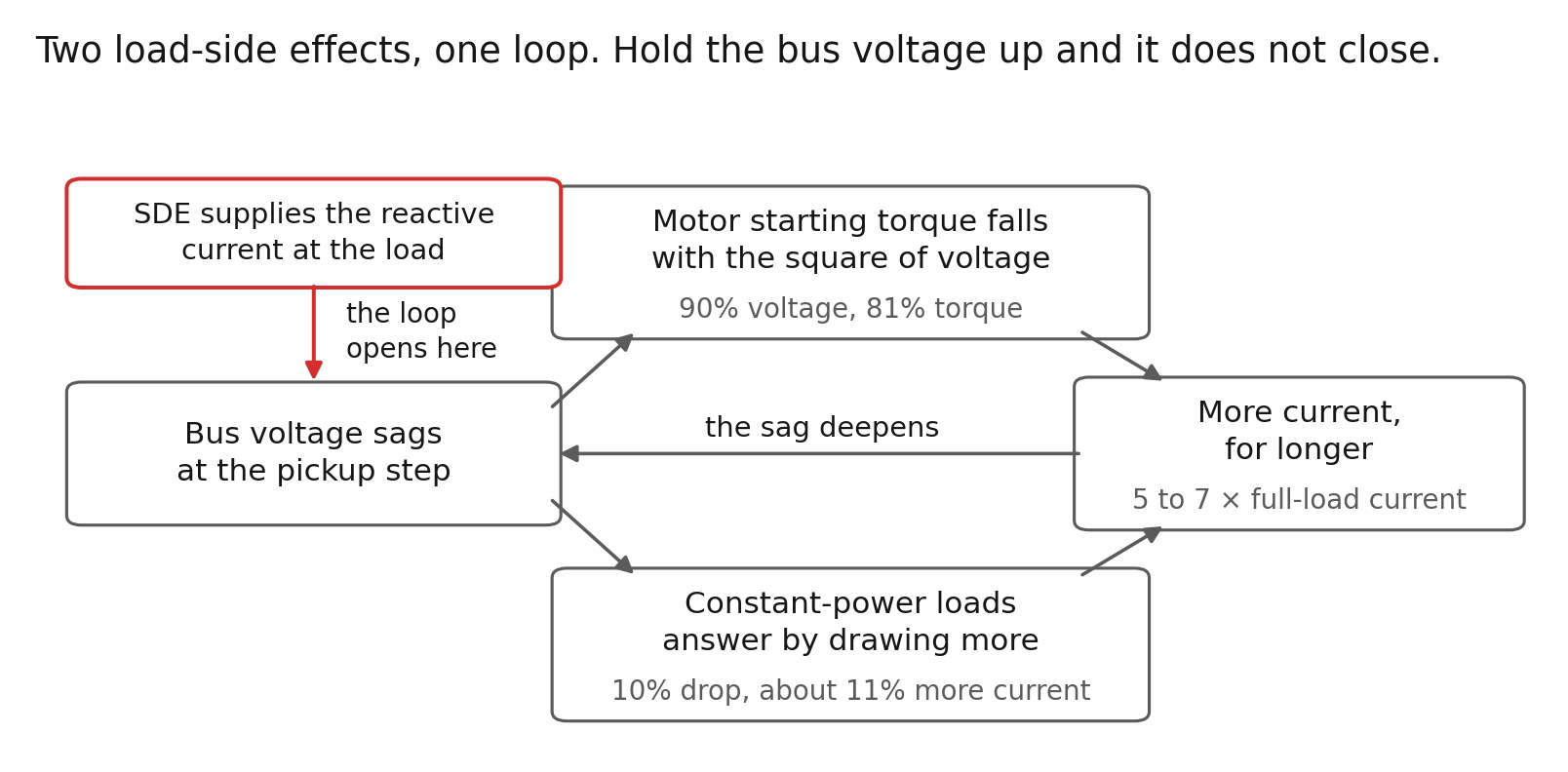
Contactors and variable frequency drives trip on deep sags. The block just picked up drops off again. Voltage stability at the load bus during pickup is the difference between a load coming back cleanly and a load coming back twice.

Signs a restoration island is running on uncontrolled current
- The block just picked up drops off again when drives and contactors trip on the sag.
- A genset trips on over-temperature while loaded under 70% of rating 2.
- Speed and voltage controls hunt, and the sets will not parallel.
- Energization transients trip fast relay elements and blow fuses on an inverter island.
- Grid-following inverters lose phase lock as the island waveform degrades.
- A pickup step waits hours for energy margin.
Path one, today: restoring with generators and legacy equipment
This is how restoration works today. Blackstart plants (hydro and gas turbines with on-site diesel start) energize cranking paths toward larger units 1. At the facility and microgrid scale, diesel and gas gensets do the same job for a building, a base or a campus.
A synchronous machine has two things an inverter lacks. Rotating inertia resists frequency change. Its fault current is several times its rated current, so relays and fuses see faults clearly 1. Neither advantage helps with the current the load draws during pickup.
Nonlinear load heating. U.S. Army TM 5-689 records transformers and generators shut down on over-temperature while loaded to less than 70% of rating. The cause is harmonic current, which raises hysteresis, eddy current and skin effect losses above what the same root-mean-square (RMS) current at 60 Hz would produce 2. A genset carrying a modern electronic load has less usable capacity than its nameplate.
Control instability. The same manual documents generator speed and voltage controls hunting when harmonics add extra zero crossings to the waveform, and paralleling becomes difficult or impossible 2. Blackstart is paralleling, repeated: each generator, each island, each tie closure.
Response time. An engine generator’s voltage regulator and governor recover from a block load over seconds. ISO 8528-5 performance classes allow several seconds of voltage and frequency recovery after a load step 6. The inrush is over in a few cycles. The regulator is still responding to the first transient when the second one arrives.
Reactive capability. Field heating bounds a generator’s capability curve on the overexcited side 7. Reactive-rich inrush pushes the field toward its limit precisely when the load needs voltage held up.
Supporting equipment. Capacitor banks give passive analog compensation. Generator regulators act on voltage. Both react to a voltage symptom after it has formed, in seconds.
Three devices share the job. In capacitor banks, reactive output falls with the square of voltage, so support drops exactly when voltage sags 5. Their switching takes seconds 9. STATCOMs and active filters respond in one to ten milliseconds, treat reactive power or harmonics as separate functions and are sized for substations, not feeders 9. Synchronous condensers bring real inertia and real fault current, but they are large, limited in siting and a capital project per location.
SDE’s role on this path. Our controller supplies the reactive, harmonic and imbalance components of load current at the point of use 8.
The generator’s controls see clean zero crossings. Its field stays inside the capability curve during pickup. On a blackstart genset, that means larger pickup steps and fewer trips on the way back up.
Path two, the future: restoring with grid-forming batteries
The Nature Communications review describes where restoration is heading 1. Inverter-based resources on the distribution system, most commonly battery storage with grid-forming control, set a local voltage and frequency reference. They energize a small island and pick up load in steps. They merge with neighboring islands once voltage, frequency and phase angle line up. The authors call this bottom-up blackstart.
The physics is sound. The binding constraint is not how much capacity sits on the feeder. It is how much of that capacity the inverter delivers at the instant a block of cold load switches on 1.
A grid-forming inverter sets the island’s voltage and frequency itself 1. It has no rotating mass and no field to overload. In its place is a hard current limit. The reactive spike of cold load pickup pushes the inverter into current limiting. Current limiting weakens droop and virtual inertia response. Voltage sags, frequency margins shrink, and the planned pickup step no longer fits 1.
The review’s test case ran on a modified IEEE 123-node feeder with 3.49 MW of peak demand and two grid-forming storage units 1.

Three problems specific to inverter islands compound this.
- Waveform. Grid-forming inverters emit harmonics rather than absorb them 10, and grid-following units on the same island lose phase lock when the waveform degrades 1.
- Protection. Inverters produce small, time-varying fault currents, so the separation between load current and fault current narrows. Energization transients then trip fast relay elements and blow fuses 1.
- Measurement. SCADA (supervisory control and data acquisition) updates in seconds, smart meters update in minutes and distribution phasor units report tens of phasors per second 1.
The review states that the practical challenge is not more data but enough observability to certify each switching action 1. The instrument side agrees. The European Partnership on Metrology’s 2026 call for proposals names the 2025 Spain-Portugal event as its motivation. It asks for waveform measurement units sampling at 500 kHz with 16-bit resolution, to cover supraharmonics between 2 and 150 kHz 11.
Restoration optimizers miss the same thing. They sequence switching and pickup using steady-state feasibility checks. The review identifies the binding constraints as dynamic: rate of change of frequency, frequency nadir, and voltage depression during reactive-rich inrush 1.
SDE’s role on this path. Reactive and harmonic current supplied locally by the correction stage never passes through the grid-forming inverter. A pickup step limited to 0.8 per unit becomes a step at 1.0 per unit, or the same step with 20% more margin against the frequency nadir.
In a weak island, source impedance is high, so harmonic current becomes harmonic voltage: harmonic voltage equals harmonic current times island impedance at the same frequency 2. Removing the harmonic current at the load keeps the island voltage clean. That keeps grid-following inverters locked and their reserve available for the next step 1.
Why SDE is critical on both paths
A pickup step sized on nameplate kVA can still drop its block. Software-Defined Electricity measures the full three-phase waveform at nanosecond resolution and corrects the current waveform digitally, at the load, at microsecond speed 8. Whether a generator or an inverter holds the reference, the source carries less non-working current.
Headroom. With the reactive and harmonic current supplied at the load, within the controller’s rating, the source’s rating goes to real power 8. Each pickup step gets larger, or the same step gets more margin. The load mix and the source’s limits still set the size of the next step 1.
Speed. Devices responding in 1 to 10 milliseconds catch part of the inrush peak 9. Voltage regulators responding in seconds miss the peak entirely 6. Microsecond correction tracks the whole peak 8.
Load bus stability. Motors start on a firmer bus 8. Drives and contactors stay connected.
Phase balance. Single-phase pickups create local voltage violations even when feeder totals look acceptable 1. Balancing phases at the load in real time removes neutral current and presents the source with equal current on all three phases 8.
Waveform. Generator governors and voltage regulators see clean zero crossings 2. Grid-following inverter phase-locked loops see clean voltage 1. Paralleling works on both paths.
Protection. Lower RMS load current, with harmonics and reactive current removed, widens the separation between load level and fault level. On inverter islands, where fault current is scarce, this recovers part of what current limiting took away 1.
Observability. Our controller measures the full waveform of the loads under correction at sub-cycle resolution, shorter than one 60 Hz cycle of 16.7 milliseconds, continuously 8. This is the class of data the review says restoration decisions lack 1 and the metrology call is working to standardize 11. With SDE, the data exists at the edge, at the moment of pickup.
Synchronization. Islands merge when real and reactive power exchange is near zero at the closing instant 1. Reactive power held at zero on both sides of the tie makes the condition easier to meet, whether the tie joins two gensets or two inverter islands.

Over the life of the genset, the windings carry 60 Hz current. The harmonic current that shut sets down at under 70% of rating stays at the load 2.
Start by measuring one feeder block before sizing the next restoration step.
This page sits under the Generation pillar. Adding generation introduces network distortions and losses, and a blackstart adds it from nothing.
Three PQ Components pages carry the mechanisms this page leans on. Impedance Matching is the headroom of a weak source during pickup. Voltage Stability is the dip under inrush and which share of it is the island’s own. Resilience is the sequence of clocks a restoration runs on.
Frequently asked questions
How does power quality affect generator stability during blackstart?
Distorted load current can make a generator’s controls hunt and its windings overheat. U.S. Army TM 5-689 documents speed and voltage controls hunting when harmonics add extra zero crossings, so paralleling becomes difficult or impossible, and generators shutting down on over-temperature while loaded under 70% of rating 2. Blackstart is paralleling, repeated. Software-Defined Electricity supplies the harmonic and reactive share of that current at the load, within the controller’s rating, so the generator’s controls see fewer extra zero crossings 8.
What is cold load pickup?
Cold load pickup is the rebound in demand when a block is re-energized after an extended outage, as transformers and motors start together 1. The Nature Communications review describes two stages: a brief inrush with substantial reactive power demand, then a thermostat-driven recovery lasting minutes above the pre-outage baseline 1. Real and reactive power share one source limit, so a source supplying 0.6 per unit of reactive power has only 0.8 per unit left for real power 1.
What is bottom-up blackstart with grid-forming batteries?
Bottom-up blackstart starts the local grid first. Inverter-based resources, most commonly battery storage with grid-forming control, set a local voltage and frequency reference, energize a small island and pick up load in steps, then merge islands once voltage, frequency and phase angle line up 1. The limit is the inverter’s hard current limit: the reactive spike of cold load pickup can push it into current limiting 1. Current that SDE supplies at the load never passes through that inverter.
Sources
- Shi, W., Bai, C. and Wang, Z. Power distribution system blackstart restoration using renewable energy. Nature Communications 17, 8498 (2026). https://doi.org/10.1038/s41467-026-76692-0
- U.S. Army. TM 5-689, ADP/Computer Electrical Installation and Inspection for Command, Control, Communications, Computer, Intelligence, Surveillance, and Reconnaissance (C4ISR) Facilities. Headquarters, Department of the Army, 10 September 2001. Sections 5-7 (Derating power equipment) and 5-8 (Generator control problems). https://www.wbdg.org/FFC/ARMYCOE/COETM/tm_5_689.pdf
- IEEE Std 3002.7-2018, IEEE Recommended Practice for Conducting Motor-Starting Studies and Analysis of Industrial and Commercial Power Systems. https://standards.ieee.org/standard/3002_7-2018.html
- IEEE Std C37.91-2021, IEEE Guide for Protecting Power Transformers (magnetizing inrush characteristics). https://standards.ieee.org/ieee/C37.91/5904/
- IEEE Std 1036-2020, IEEE Guide for the Application of Shunt Power Capacitors (reactive output proportional to the square of applied voltage). https://ieeexplore.ieee.org/document/9373058
- ISO 8528-5:2025, Reciprocating internal combustion engine driven alternating current generating sets, Part 5: Generating sets (transient performance classes G1 to G4, voltage and frequency recovery times). Edition 6, May 2025, superseding the withdrawn 2018 and 2022 editions. https://www.iso.org/standard/85960.html
- IEEE Std 67-2005, IEEE Guide for Operation and Maintenance of Turbine Generators (generator capability curve, field heating limit). Inactive-Reserved since 25 March 2021. https://standards.ieee.org/standard/67-2005.html
- 3DFS. Software-Defined Electricity: Optimized Electrification, Chapter 1 (nanosecond measurement, microsecond correction, power factor, harmonic, phase balance and impedance correction). Company white paper.
- 3DFS. SDE Technical Training Document, response-time comparison (active harmonic filter 1 to 10 ms, STATCOM 1 to 5 ms, capacitor banks 1 to 3 s). Internal document.
- Porter, K. Location, location, location: managing voltage in weak grids. Watt-Logic, 24 October 2025 (grid-forming inverters typically emit rather than dampen harmonics). https://watt-logic.com/2025/10/24/location-location-location-managing-voltage-in-weak-grids/
- EURAMET, European Partnership on Metrology, Call 2026, Selected Research Topic SRT-i15: Grid waveform metrology for transient characterisation and harmonisation. https://www.metpart.eu
- U.S.-Canada Power System Outage Task Force. Final Report on the August 14, 2003 Blackout in the United States and Canada: Causes and Recommendations, 2004-04, p. 1 (estimates of total costs in the United States between 4 billion and 10 billion dollars). https://www.energy.gov/sites/default/files/oeprod/DocumentsandMedia/BlackoutFinal-Web.pdf
- Ingarra, N. Understanding the Thermodynamics of Alternating Current. In Compliance Magazine, 2026-10-30. One author’s proposed framework for apparent power, inverter losses and motor efficiency; cited for the statements that reactive power is required for an AC motor to produce torque, that the source feeding an inverter must supply the apparent power, and that inaccurate power calculations can lead to improperly sized components and possible thermal issues. https://incompliancemag.com/understanding-the-thermodynamics-of-alternating-current/
Version 2.1