
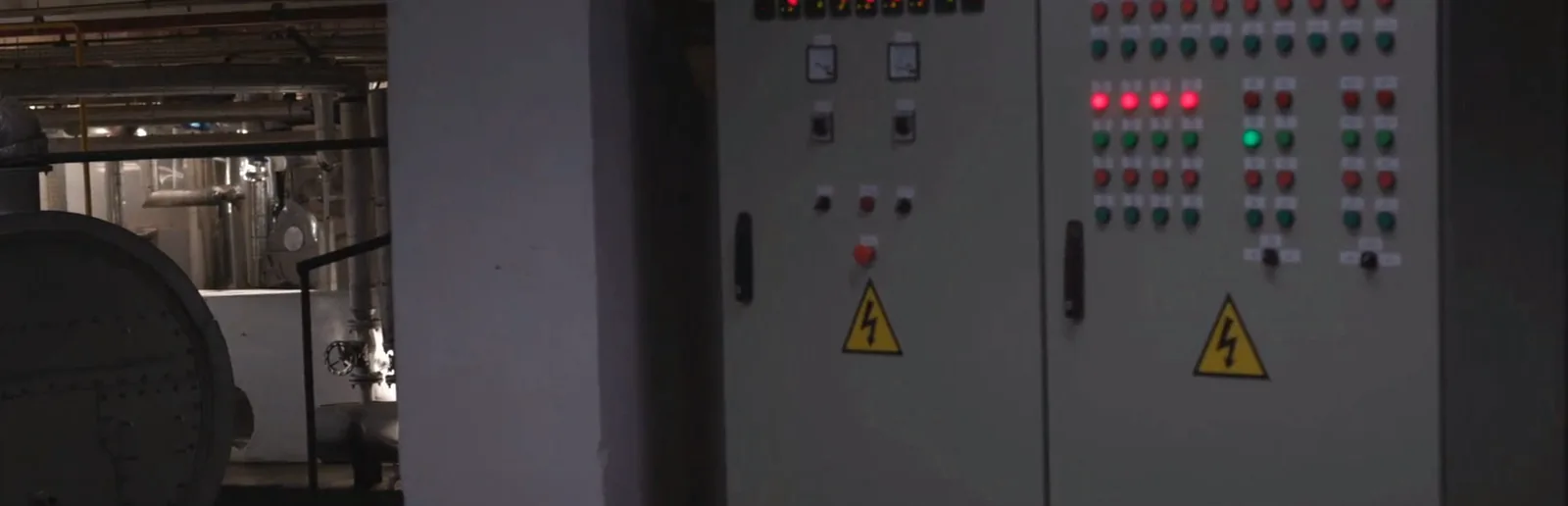
Drives, servers and LED drivers draw current in pulses, and the pulses are harmonics. They heat cables, transformers and the neutral. The panel meter hides them inside one averaged number. We correct them at the panel, each cycle.
A clean alternating current is one sine wave at 60 Hz. A variable-speed drive, a server power supply or an LED driver switches its current on and off many times a cycle. What it draws is a pulse. A pulse is the 60 Hz sine wave plus a stack of harmonics at 180, 300, 420 Hz and up 1.
Each harmonic is a current of its own. It heats the wire, loads the transformer and pulls the voltage out of shape, but does no work.
What harmonics are
The supply side of the panel carries less harmonic current. The wire from the panel to the load still carries the full distorted current. Correction runs through the 23rd harmonic, so higher orders remain 6.
- Transformers. Windings that feed drives and servers. In winding eddy-current loss, one ampere of 13th harmonic costs a transformer 169 times one ampere at 60 Hz 7.
- Neutrals. Panels that feed single-phase electronics. Triplen harmonic currents add in the neutral instead of canceling, so the neutral can carry more than a phase 9.
- Capacitor banks. Banks installed for power factor. A bank does nothing for harmonics and can resonate with the source near the harmonic a drive draws most 14.
- Mixed-load panel. An independently facilitated test at 208 V. With one VectorQ2 unit on, current THD fell from 26, 21 and 27% to 5.5, 6.3 and 5.2% on the three phases 17.
The arithmetic is short. For a current measured over whole cycles, the root-mean-square (rms) value is the square root of the sum of the squares of every frequency in it 2. Heating is at least I²R, so a harmonic current adds loss in proportion to its square.
Total harmonic distortion in the current, THDi, is the harmonic content as a share of the fundamental. At 25% THDi the rms current is 3% higher and the heating 6% higher. At 50% it is 12% and 25% 3.
An ideal six-pulse drive rectifier draws 31% THDi on its own 4. A smartphone charger measured over 200% 5.
What they cost
Transformers pay twice. Joule loss follows the sum of squares. Winding eddy-current loss follows the sum of squares multiplied by the square of the harmonic order 7. That is why K-rated transformers exist 8.
We found no published national figure for what harmonics cost U.S. facilities. So read the temperature rise directly, then price a year of it at the energy rate.
The neutral pays for the triplens. Third, ninth and fifteenth harmonic currents do not cancel between the phases. They add, so a neutral sized for near-zero current can carry more than a phase 9. One published data center feeder carried a neutral at 42% of its lowest phase current 10.
What a site is measured against
IEEE 519 holds voltage distortion on a bus of 1 kV or below to 5% for any single harmonic and 8% in total 11. Current is judged by total demand distortion, TDD. TDD is the harmonic current through the 50th order as a share of the site’s maximum demand current. The limit runs between 5% and 20%, depending on how stiff the utility connection is 11.
THDi rises at light load while TDD does not, because TDD divides by a fixed number. The standard is met on 3-second and 10-minute statistics 11,12. A panel meter is for information, not for analysis.
How the industry has dealt with it
The first answer was to buy the problem away: K-rated transformers, oversized neutrals, derated motors. It works, and it costs every year the loads are there.
The second, the capacitor bank, corrects power factor and does nothing for harmonics. One leading maker’s worked example puts a 350 kvar bank on a 630 kVA transformer. Together they resonate at the 5.5th harmonic, right where a drive is loudest 14. The third, the passive tuned filter, takes one order at a time and detunes as its parts age.
The fourth, and the closest comparison, is the active harmonic filter. A good active filter cancels harmonics to the 51st order within two cycles 15,16. It measures harmonics and injects harmonics, and nothing else. Power factor and phase balance go to other boxes, each with its own study, losses and fan.
How Software-Defined Electricity handles it
The controller treats the whole current as one waveform. It sits behind its own breaker on the panel bus, in parallel with the loads. It measures to the 53rd harmonic and corrects through the 23rd. It responds in under 5 microseconds and supplies the harmonic current the loads want from its own terminals, when they want it 6.
It corrects that waveform digitally and continuously, so nothing detunes as the parts age. The same pass corrects power factor and rebalances the phases, because all three are the same current 6. Those harmonic amperes leave the feeder, the transformer and the utility meter.
The independently facilitated test at the 208 V mixed-load panel used two VectorQ2 units and a power quality analyzer 17. In the same report, the ratio went the other way on a nearly unloaded test motor. There the fundamental fell faster than the small harmonic current 17.
We assessed two server racks and recorded 6.4% falling to 1.9% and 13.2% to 3.6% 18. What changes is everything upstream of the panel, where the transformer, the neutral bus and the bill live.
Where it matters
This is the Consumption pillar, where the loads inside the building produce the distortion. A data center is the pure case. Every load is a rectifier, the neutral carries the triplens and the transformer is bought K-rated. An industrial plant meets it as heat from its drives and as nuisance trips. A ship meets it hardest, because a generator is a weak source.
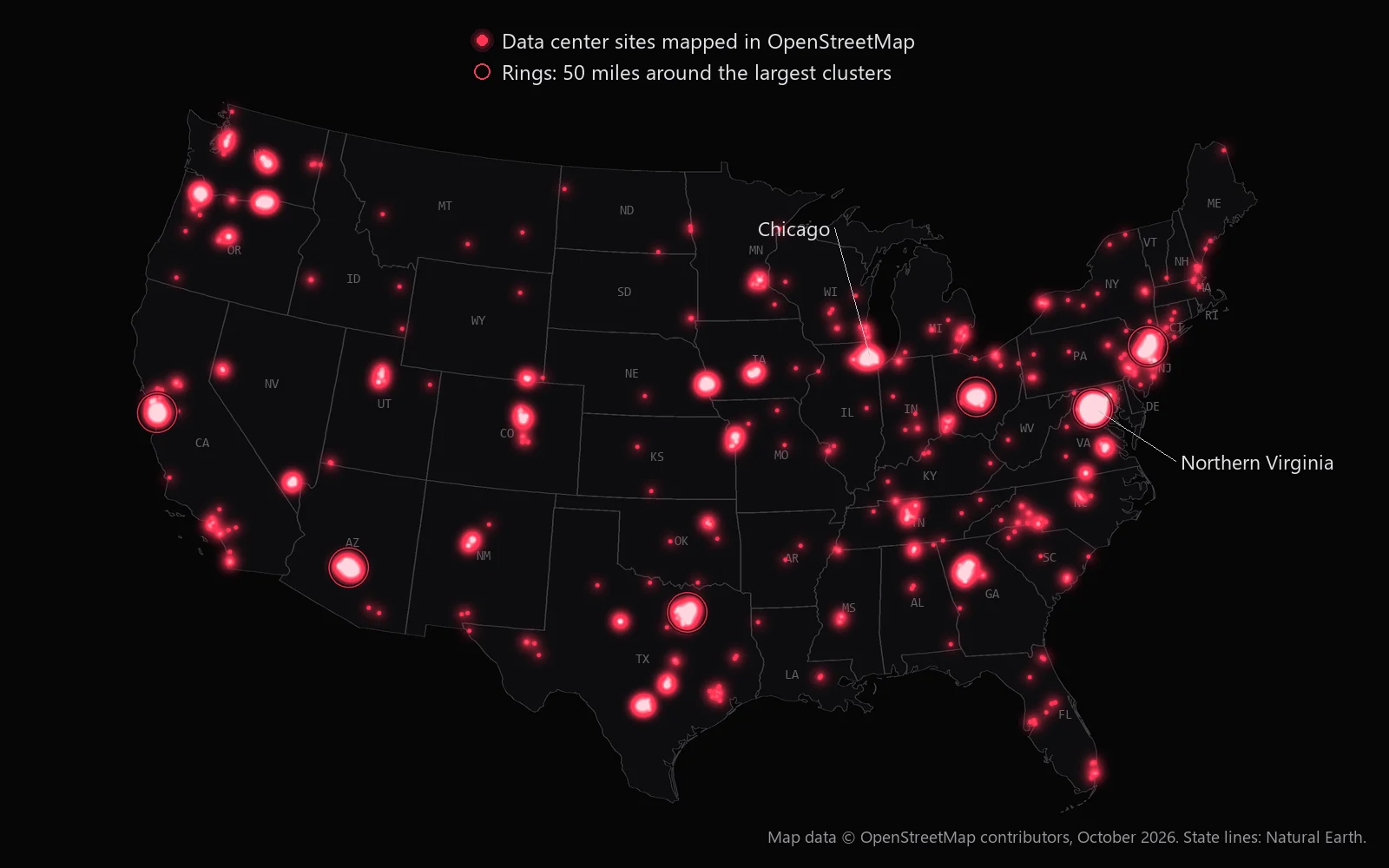
In the news. Bloomberg analyzed Whisker Labs home sensor readings from February to October 2024 and found that more than three-quarters of the highly distorted power readings in the United States are within 50 miles of significant data center activity, and that more than half of the tracked households with the worst distortion are within 20 miles 20. Distorted power can make home electronics run hot and make the motors in refrigerators and air conditioners rattle. The sensor data does not point to a single cause, but Bloomberg found the link to data center proximity too strong to be coincidental. Two utilities dispute the readings 20.
Read more: Consumption, where nonlinear loads produce waveform distortion.
What to measure
Ask for a Class A meter reading at the point of common coupling, before and after. Read TDD, not THDi, against the IEEE 519 table for the site’s short-circuit ratio 11,12. Read the neutral current on any panel that feeds single-phase electronics. Read the transformer temperature after a week.
Expect voltage THD to move less than current THD, because the share of distortion the utility delivers stays 19. Transients and switching noise above 2 kHz are a different problem for a different device. If the current numbers do not fall, the correction is not working, and that is a test anyone can run.
Sources
- 3DFS, VectorQ Technical Overview (current revision), p. 12. First-party.
- MIT OCW 6.622, Lecture 4 (Perreault), pp. 3-4. https://ocw.mit.edu/courses/6-622-power-electronics-spring-2023/mit6_622_s23_lec04.pdf
- The Green Grid, White Paper 55, Table 4, p. 20.
- Heydt, Electric Power Quality, Table 10.8.
- Michalec et al., Energies 2021, 14(12), 3665, Table 3. https://doi.org/10.3390/en14123665
- 3DFS, VectorQ Technical Overview (current revision), Technical Specifications table and p. 14. First-party.
- León-Martínez et al., Environments 2023, 10(10), 177, Eq. (5)-(7). https://doi.org/10.3390/environments10100177
- A leading maker’s K-factor technical paper 1TQC194900E0001 (2023), quoting UL 1561 and IEEE C57.110-2018.
- Lazar et al., Energies 2026, 19(7), 1743, Eq. (12), scenario S3. https://doi.org/10.3390/en19071743
- Rasmussen, a leading maker’s White Paper 38, p. 11.
- IEEE 519-2022, Tables 1 and 2, clauses 3 and 5.
- IEC 61000-4-30:2025, clauses 4.4 and 4.5.
- A leading maker’s fuse and motor protection guide, Motor Protection, Voltage Unbalance and Single-Phasing (2005), derating table.
- A leading maker’s Electrical Installation Guide, Risk of resonance due to power-system harmonics. https://www.electrical-installation.org/enwiki/Risk_of_resonance_due_to_power-system_harmonics
- A leading maker’s active harmonic filter catalog, p. 4-45.
- A leading maker’s harmonic correction unit technical data TD156001EN, Table 7.
- Independent third-party verification report, SDE Technology Verification Testing, pp. 13-14. Facilitated by an independent third party with 3DFS.
- 3DFS, electrical network analysis of server racks at a data center. First-party.
- The Green Grid, White Paper 55, p. 24.
- Bloomberg, “AI Needs So Much Power, It’s Making Yours Worse,” by Leonardo Nicoletti, Naureen Malik and Andre Tartar, December 27, 2024. Bloomberg analysis of Whisker Labs and DC Byte data. https://www.bloomberg.com/graphics/2024-ai-power-home-appliances/
Version 5.1