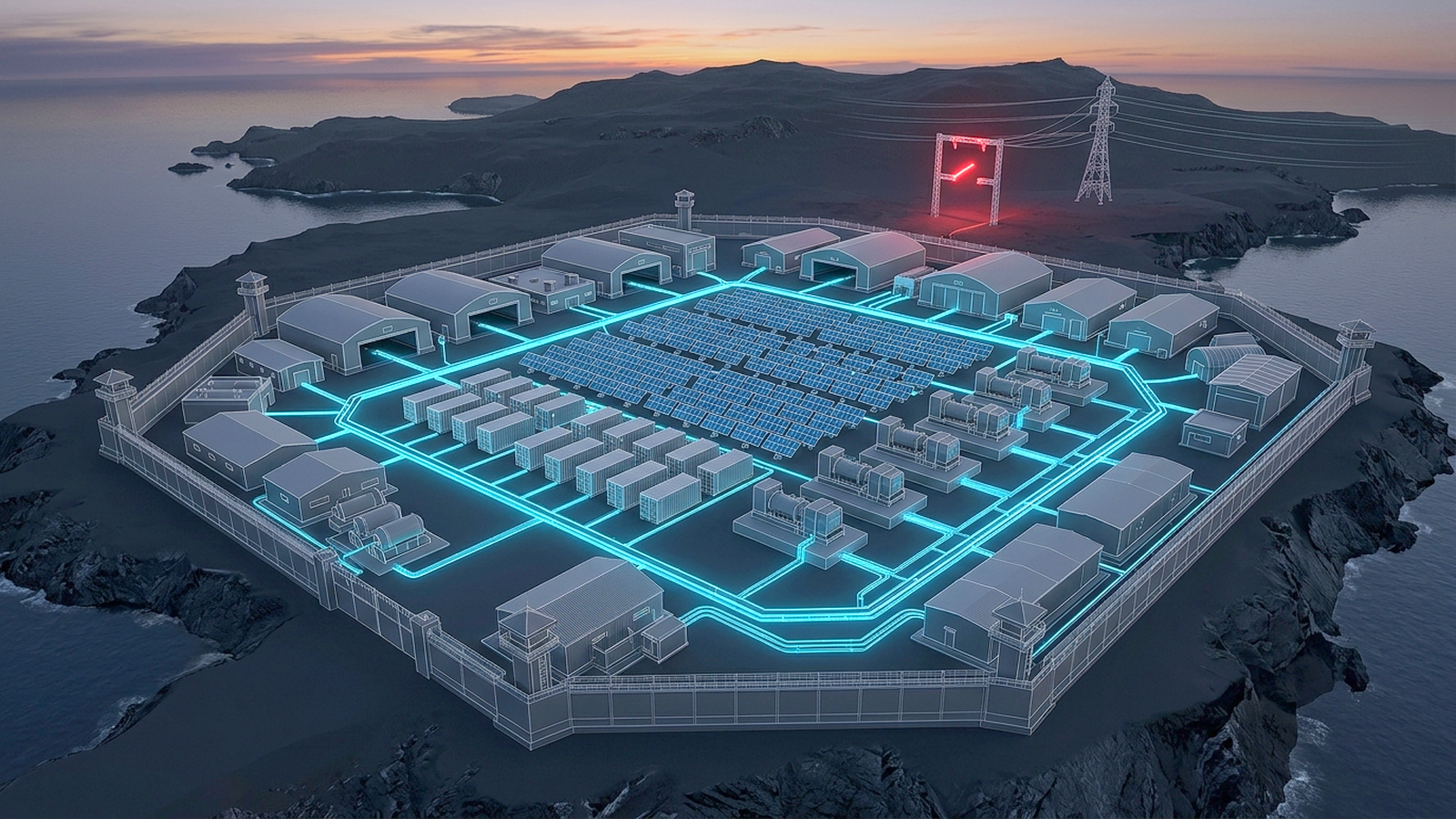
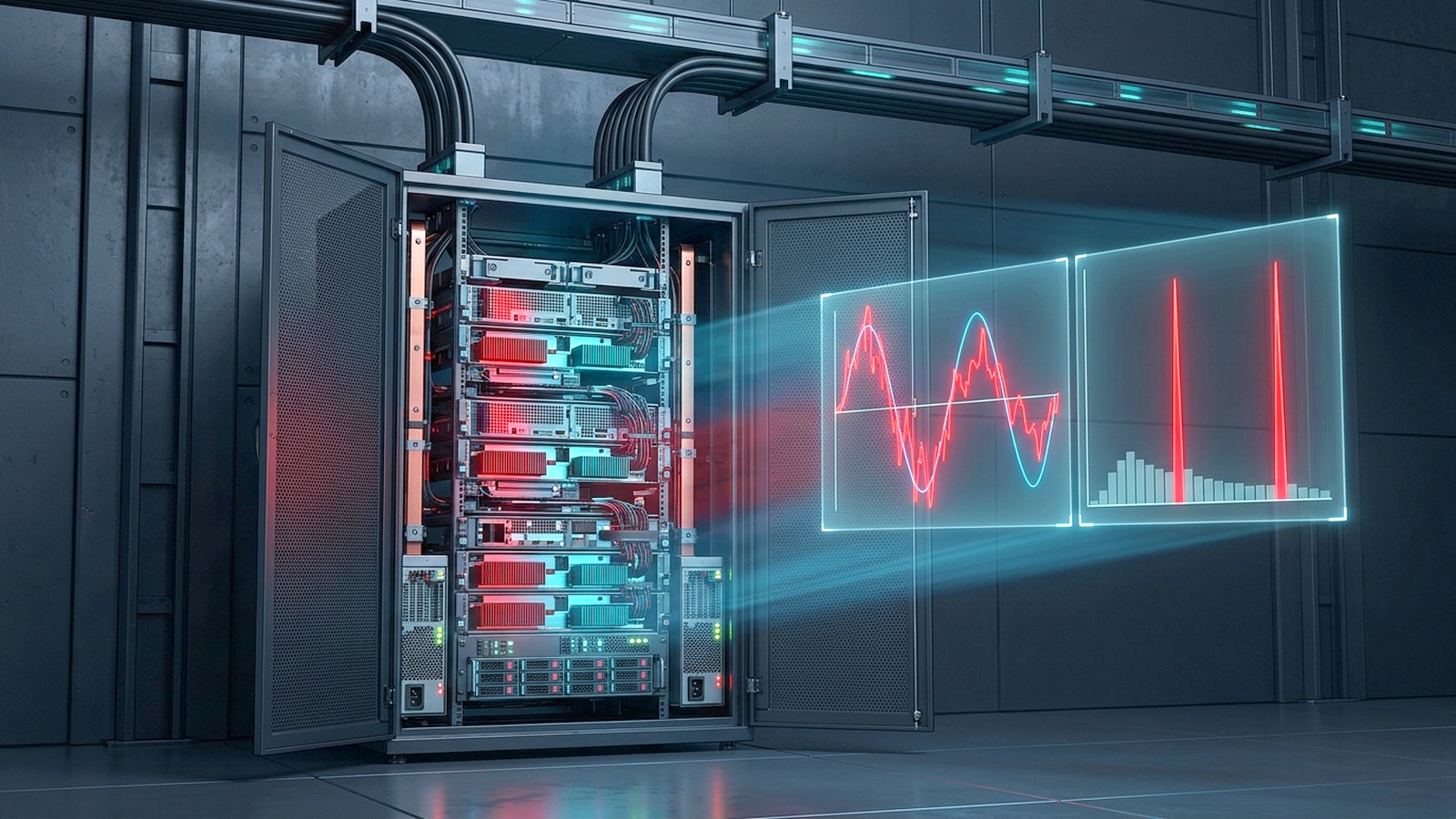

Yes, by the mechanism NERC describes. Its July 2025 white paper names uninterruptible power supply (UPS) units and power supplies in IT equipment, and variable speed drives in cooling, as examples of data center harmonic sources (NERC white paper, p. 33). All three are power electronics (NERC, p. 33). The paper gives no harmonic figure for GPUs. It mentions GPUs when it describes AI training and inference facilities (NERC, p. 5).
What the NERC paper says
The source is the NERC Large Loads Task Force paper “Characteristics and Risks of Emerging Large Loads,” dated July 2025 (NERC). Page 32 says the extensive use of power electronics could make data centers “a significant source of harmonics” unless filtering is designed to address them (NERC, p. 32). Page 33 names the sources as UPS units and power supplies on the IT side and variable speed drives on the cooling side (NERC, p. 33).
Page 4 adds that cooling systems typically use variable speed drives, inverters and other equipment that can create harmonics and increase reactive power demand (NERC, p. 4). The same page notes that power delivery for AI data centers commonly leaves out UPS protection for the IT equipment (NERC, p. 4). Figure 3.11 on page 33 shows voltage distortion at one data center facility before and after harmonic correction. The paper says voltage distortion was greatly reduced once mitigation was in place (NERC, p. 33).
The paper treats harmonics in its chapter on risks to the bulk power system (NERC, p. 32). Its conclusion ranks harmonics as a low priority risk under power quality (NERC, p. 39). Inside the building, the same pulsed current heats cables, transformers and the neutral (3DFS harmonics page). The paper also notes that filters in the power electronics of these loads produce reactive power and can give a load a leading power factor (NERC, p. 26). A separate article on leading power factor covers that.
The mechanism
A server power supply, a variable speed drive or an LED driver switches its current on and off many times a cycle, so what it draws is a pulse (3DFS harmonics page). A pulse is the 60 Hz sine wave plus a stack of harmonics at 180, 300, 420 Hz and up (3DFS harmonics page). Each harmonic heats the wire, loads the transformer and pulls the voltage out of shape, but does no work (3DFS harmonics page). A panel meter folds them into one averaged number (3DFS harmonics page).
Where it shows up
The neutral is the first place to look. Triplen orders, the third, ninth and fifteenth, add in the neutral instead of canceling, so the neutral can carry more than a phase (3DFS harmonics page). A transformer is heated twice over. Joule loss follows the sum of squares, and winding eddy current loss also grows with the square of the harmonic order (3DFS harmonics page). That is why K-rated transformers exist (3DFS harmonics page).
One published measurement shows the scale. An equipment maker’s case study measured 11.7 to 14.4% current distortion on the three phases of a data center feeder from a UPS to a PDU panel board (Rasmussen, White Paper 38). The site was a room of 16 rack cabinets behind a 40 kW UPS, and servers, disk systems and routers were the main load (White Paper 38). The study put the feeder K-factor at 1.25, against legacy guidance of K-15 or K-21 (White Paper 38). In the branch circuits, the neutral current came mostly from load imbalance between phases and not from harmonics (White Paper 38). The study does not describe GPU equipment, so its figures are not a GPU rack measurement (White Paper 38). The 3DFS data centers page cites the same study.
What the usual fixes do
The first answer was to buy the problem away with K-rated transformers, oversized neutrals and derated motors (3DFS harmonics page). A capacitor bank corrects power factor and does nothing for harmonics (3DFS harmonics page). A passive tuned filter takes one order at a time (3DFS harmonics page). An active harmonic filter injects current to cancel harmonics, reaching the 51st order within two cycles (3DFS harmonics page). It can also correct power factor or balance the load, one function at a time (3DFS harmonics page). The right choice depends on which harmonic orders the racks produce, and only a measurement shows that.
What 3DFS does
The 3DFS controller treats the whole current as one waveform (3DFS harmonics page). It measures to the 53rd harmonic and corrects through the 23rd, and the same pass corrects power factor and phase balance (3DFS harmonics page). Correction runs through the 23rd harmonic, so higher orders remain (3DFS harmonics page). The wire from the panel to the load still carries the full distorted current (3DFS harmonics page).
Critical perspective
NERC calls data centers a source of harmonics and shows one facility with excessive voltage distortion (NERC white paper, p. 33). Its conclusion still ranks harmonics as a low priority risk (NERC white paper, p. 39). The feeder study cited above points the same way. It put the feeder K-factor at 1.25 and credited modern IT power supplies for the low harmonic current (an equipment maker’s case study, White Paper 38, pp. 2 and 12). The record argues for measurement, not alarm.
The gap is in what the limits measure. IEEE 519-2022 applies its distortion limits at the user’s point of common coupling (IEEE 519-2022). It addresses steady state and warns that transient conditions may exceed its limits (IEEE 519-2022). NERC shows a 50 MW block of an AI training data center ramping at 1.9 p.u. per second for about 250 milliseconds (NERC white paper, p. 6). Jittery spikes followed while training ran (NERC white paper, p. 6). NERC adds that the transition to such pulses may bring even higher harmonic distortion (NERC white paper, p. 32). Neither the feeder study nor the IEEE limit describes that load.
Inside the building the risk stays with the owner. One Texas utility’s tariff makes the customer responsible for protecting equipment that distorted wave forms can affect (Oncor tariff, section 5.5.3, PDF p. 58). IEEE 519 sets its limits at the point of common coupling, the interface between source and loads (IEEE 519-2022).
A hall can pass IEEE 519 at the point of common coupling and still heat a neutral or a transformer at the panel. A reading taken at idle, or averaged over a long interval, says little about a training step. Measure at the panel during a training run. Take one reading at its start and one at full load.
Questions about GPU racks and harmonics
Do GPU servers cause harmonics? Server power supplies are power electronics, and NERC names power supplies as a data center harmonic source (NERC, p. 33). NERC gives no GPU figure, so the amount at a given rack is a measurement, not an assumption (NERC, p. 33).
Which harmonic orders matter in a 208 V rack? The triplens, orders 3, 9 and 15, matter on any panel that feeds single phase electronics, because they add in the neutral (3DFS harmonics page).
Does a UPS remove them? NERC lists UPS units as a harmonic source, not as a cure (NERC, p. 33). NERC also notes that AI data centers commonly run the IT equipment without UPS protection (NERC, p. 4).
What is the first measurement? Ask for a Class A meter reading at the point of common coupling before and after any correction, and read total demand distortion against the IEEE 519 table for the site (3DFS harmonics page). Read the neutral current on any panel that feeds single phase electronics, and read the transformer temperature after a week (3DFS harmonics page).