


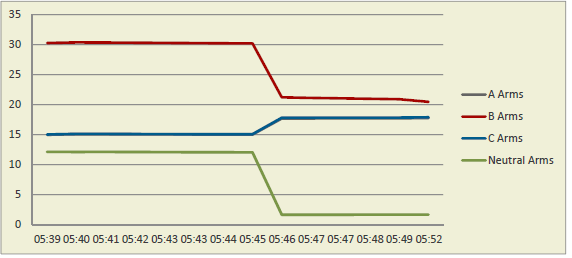
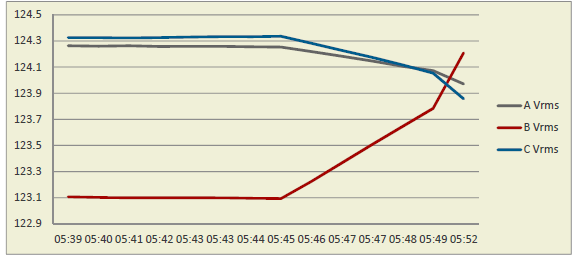
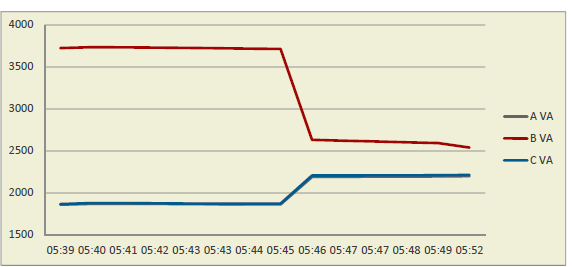
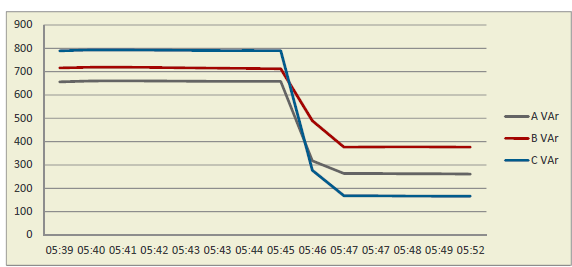
The performance claims of 3DFS Technology have been met with some skepticism, so as a teaser, here is some data of a North Carolina 3 phase facility’s electrical network at the point in the time (05:45) when the Vector Q2 was turned into its correction mode. The data provided was gathered by a Tektronix PA4000 power analyzer – overseen and verified by a Tektronix senior field Engineer and shows the readings as the 3DFS device went to work. The data speaks for itself and will hopefully spark more skepticism due its mesmerizing content.
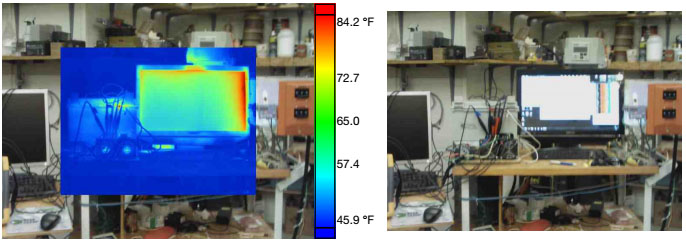
This is a thermal image of the Vector Q2 connected in parallel to the main breaker panel – obtained with a thermal imager.
Below are graphs from the data of the PA4000 power analyzer – captured on the 10th of February 2014 at 15:05:39
Root-Mean-Square Current
Root-Mean-Square Voltage
Watts
Power Factor

Volt-ampere
Volt-ampere Reactive
Download the PDF: PA4000-TestData
Reading a before-and-after capture
The Glossary defines a true-RMS meter as one that computes rms from the sampled waveform rather than inferring it from the average. Average-sensing instruments read a distorted or pulsed current low.
Read true power factor, not displacement power factor. If the two differ, the problem is the shape of the current, and a capacitor bank will not fix it. The Power Factor article splits the two parts: timing and shape.
Expect apparent power, current and reactive power to fall with correction on. Expect the active power at the connection to include the controller’s own draw. The change sits upstream of the panel. The branch circuits from the panel to the loads carry the same current as before, as the Electric Optimization article notes.
Evidence a third party can check
The SDE Summary cites a test that an independent third party reported, and offers its capture and method on request. We would rather somebody independent read it than have anyone take our word. We also recommend that a third party collect the baseline.
Where this stands today
The VectorQ2 pilot starts with a network analysis on site. A written baseline report records what we measured, with which instruments and when. The pilot closes on an instrumented result, good or bad. That result names who measured it and on what date. The Press and Case Studies page keeps our case studies with the papers behind them.
Related reading
- Power Quality Risk Analysis: turns waveform recordings into power quality decisions
- Request a site analysis: an engineer replies with what we would measure first
- Voltage Stability: correct current, voltage follows



Comments
7 responses to “Show Us The Data”
I guess I am not the only one that thinks the Tektronic interface looks like the star trek one.. LoL You guys are doing amazing things 🙂
•
Although your product seemed like another capacitor and filter device, after seeing the data and looking at the size of the Vector Q2 I am convinced that you are on to something here. Just sent you a job application
•
Dear 3DFS Team
I believe you show a very good performance; the savings are full 2,11% ! This is amazing.
•
James, as for the savings in Watts, yes you are correct somewhere around 2% at a 2.3kW load. The VectorQ2 consumes around 120W, with higher loads the savings would be much more substantial, could you get better savings with a capacitor or harmonics filter?
Cheers,
Jerome
•
This article and many other on your website are very interesting.
•
I think that the power quality and reliability improvements are much more important than energy savings. Managing the operations in a data center, having stable power when switching from generator back to utility power, just the stability that the Vector Q2 would provide is worth its weight in gold twice over.
•
Looks like the instrument is a variation on the old voltech power analyzer, very reliable instrument. I have worked in the power quality industry for over a decade and have never been more impressed than I am with 3DFS.
•